
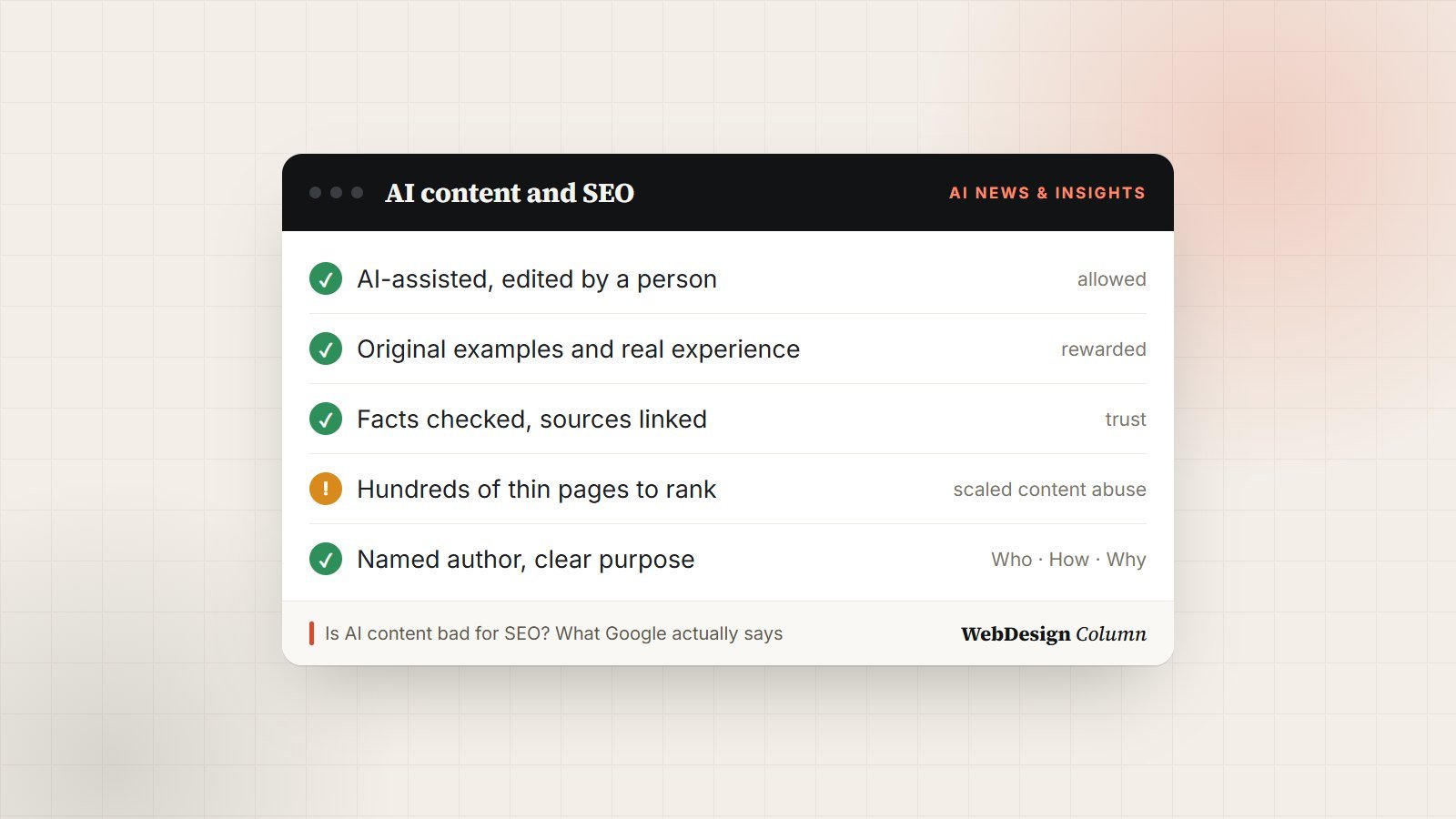
Short answer: no, not by itself. Google doesn’t rank pages lower because AI helped write them. It ranks pages lower when they’re unhelpful, unoriginal or made mainly to game search results, and a lot of AI content happens to be exactly that. The tool isn’t the problem. How you use it is.
It’s one of the most common questions about content right now, and most answers online are guesses. So here’s what Google has actually published on the subject, where AI content gets sites into trouble, and how we use AI on this site without cutting corners.
Key takeaways
- Google judges content by quality and purpose, not by who or what wrote it. Mass-producing low-value pages to rank breaks its “scaled content abuse” spam policy, with or without AI.
- AI drafts rank when a person adds what AI can’t: real experience, checked facts, original examples and a clear point of view.
What Google actually says
Google’s clearest statement is its February 2023 post, Google Search’s guidance about AI-generated content. The core message: Google rewards high-quality content however it’s produced, and “appropriate use of AI or automation is not against our guidelines.” What is against its guidelines is using automation to generate content primarily to manipulate search rankings.
Since then, Google has drawn the line more clearly:
- In 2024, Google’s spam policies started naming “scaled content abuse”: the practice of producing many pages mainly to manipulate rankings, with little value for readers, “no matter how it’s created”. AI isn’t singled out; mass-produced filler is.
- The same year, Google folded its “helpful content” signals into its main ranking systems in 2024. Its guide to creating helpful, people-first content is the best checklist Google offers, AI or not.
- In January 2025, Google’s human quality raters were given guidance that pages whose main content is auto-generated with little effort, originality or added value can receive the lowest rating. Raters don’t rank pages directly, but their guidelines show what Google’s systems are trying to reward.
Put together, the rule is simple: Google doesn’t care who typed the words. It cares whether the page is the most useful answer it can show.
 FreeHTML
 PremiumAstro
 FreeHTML
 PremiumAstro
 FreeHTML

 FreeHTML

 FreeHTML

 FreeHTML
Where AI content goes wrong
Most “AI content got my site penalized” stories, when you look closely, are really stories about these problems:
- It says nothing new. A model writing from what’s already online produces an average of what’s already online. If ten pages rank for a query and yours says the same thing, there’s no reason to rank it eleventh, let alone first.
- There’s no experience behind it. Google’s quality guidelines put weight on first-hand experience (the first “E” in E-E-A-T). A model hasn’t fixed a slow checkout or run a redesign, and readers can tell.
- It’s confidently wrong. AI tools still state wrong facts, outdated numbers and invented sources in the same calm tone as correct ones. One wrong price or broken code sample costs trust fast.
- There’s too much of it. Publishing fifty thin pages in a week is exactly the pattern the scaled content abuse policy describes.
- It all sounds alike: same phrases, same structure, same safe conclusions. People stop reading, and engagement drops with them.
How we use AI on WebDesignColumn
We do use AI, and we say so in our editorial policy: AI tools help with research, outlines and first drafts. A human editor then rewrites every article, checks every fact and adds what AI can’t, such as our own screenshots, tested code, real project numbers and opinions. Two rules sit on top of that:
- We don’t invent experience. If we haven’t done something, the article doesn’t pretend we have. A “from experience” note only appears when the story is true.
- We check every claim. Prices, limits, version numbers and quotes are checked against the original source, and important ones are linked so you can check them too.
Is that slower than pressing “generate” fifty times? Much. It’s also the only version I’d want my name on.
A workflow that keeps AI content safe for SEO
- Start from the reader’s question, not a keyword list. Write down what someone searching for this actually needs to do next.
- Use AI for what it’s good at: research summaries, outlines, a rough first draft, alternative headlines.
- Add what only you have: your numbers, screenshots, code you’ve run, a client situation you can describe honestly, a clear opinion.
- Check every fact against a primary source, and link the important ones.
- Rewrite it in your own voice. Cut the filler sentences, the generic intro and the conclusion that repeats the article.
- Publish at the pace you can edit, not the pace the tool can produce.
Before you publish an AI-assisted page
- Something original: a fact, example, image or opinion the top results don’t have.
- Facts checked and important ones linked to the source.
- Named author with real credentials and an author page.
- Answer in the first paragraph, details after.
- Read aloud once. If it sounds like nobody in particular wrote it, rewrite it.
Should you disclose that you used AI?
Google’s helpful content guide suggests thinking about “Who, How and Why”: who created the content, how it was created, and why. It encourages explaining how automation was used where readers would reasonably expect it. A short note in your editorial policy, like ours, covers most sites. What you shouldn’t do is put a real person’s name on content they never read, or invent an author.
What about AI Overviews?
Google’s AI Overviews and assistants like ChatGPT now answer simple questions directly, which means fewer clicks for pages that only restate common knowledge. The pages that still get cited and clicked are the ones with something specific: original data, clear steps, real examples and a direct answer near the top. That’s the same thing that protects you from the quality problems above. AI-assisted or not, generic content is losing on both fronts.
Frequently asked questions
Will Google penalize my site for using AI content?
Not for using AI. Google has said appropriate use of AI is not against its guidelines. Sites run into trouble when they publish large amounts of low-value content to manipulate rankings, which breaks the spam policies however the content was made.
Can Google tell if content was written by AI?
Google hasn’t said it ranks pages by whether they look AI-written, and public AI detectors are unreliable. What Google’s systems do look for is the outcome: whether the page is original, accurate and useful. Focus on that and detection stops mattering.
Can AI-written articles rank on the first page?
Yes, when they’re genuinely the best answer. In practice that almost always means a person has edited them heavily and added experience, original examples and checked facts.
Should I rewrite old AI content on my site?
Look at it in Search Console first. Pages that get impressions but few clicks, or none at all, are the best candidates: improve them with real detail, merge thin pages into one stronger guide, or remove pages nobody needs.












Leave a Reply